Monday, June 6, 2016

Sunday, January 11, 2015
(35) Family pictures.
In 2004, after quite a few years, I was visiting our relatives in the Czech Republic and in Slovakia. One of the first I saw was my wife’s aunt, living at the time in Cheb, in a two-bedroom flat, together with her husband and her brother. At the beginning of my two-day visit, I made a few photographs, to comply with my wife’s wishes. Back in my hotel I downloaded the pictures in my laptop, and next day went back to see the aunt again and present the photographs. The moment the first of them appeared on the screen, a group photo of the three of them, the aunt – more than 70-years old at the time – exclaimed in horror „Jesus Christ, how horrible I am looking!!!“. The same expressions of horror continued each time she saw her likeness on the screen. At the time I did not think much of that little episode.
Next group of relatives I visited was my sister in Prague, together with her husband, daughter and the daughter’s son. And again, right on my arrival I made a few group photographs of us all, downloaded them in the laptop, and prepared a presentation. This was watched by all of us. The moment the first picture appeared on the screen my sister exclaimed with utter horror in her voice „Jesus Christ, do I really look this horrible?!“. Her daughter remarked drily „Me too - is it possible to erase these pictures? “... Looking at the pictures later with my sister’s husband and grandson we all agreed that the pictures are showing them all exactly as they were, neither flattering, nor un-flattering.
The scene was repeated a few days later in the house of my cousin in Hradec Králové. The moment she saw herself on the screen, the cousin's wife began lamenting „...how horrible do I look in this picture ...“.
Exactly the same was repeated with my aunt in Bratislava, at my cousin’s
and her daughter, my sister-in-law’s place, friends in Nitra, and, finally, in
the house of my friends in Tornal’a. The women, all of them bar none, saw
nobody on the screen but themselves, and all of them, absolutely all!, were
unhappy with their looks. None of them made any remark about other people on
the screen, about quality of the picture, about the digital process (at the
time, none of them saw a digital camera, or a lap-top computer).
On the way home I was forced to wait for couple of hours at the
Singapore airport. After a long walk along the mile long hall, I, like
most of my fellow-travellers, ended up slumbered in front of the large
television screen. At first, I did not pay much attention to it, but
eventually a few familiar words have drawn me into watching it: Hitler,
Rommel, desert fox, Montgomery, etc.
On the screen there was an interview with an old married couple of
Arabs, who lived under what looked a heap of rocks on an elevation in
a Northern African desert. They were describing a tank battle that
took place some 30 years previously in a shallow valley not far from the
hillock on which they lived.
First, the husband: pointing with his hand he said that from that direction there were coming dark beetles, which later we knew were tanks; from that direction, there were different beetles coming. They started shooting at each other, the noise was deafening. Soon, smoke and dust covered it all. The smoke and dust were blown in our direction, after a while I was unable to see anything. Our goats were scared and tried to hide in the dark corner of the house. When it all died down, next day, I went there. I found many broken vehicles and among them scattered dead foreign men in strange clothing...
Next, the wife: I heard tremendous noise, I was frightened and tried to hide in the house, to no avail, the noise was too strong even inside. I covered my ears, which did not help either. I did not know what to do and I cried. I did not know how long the noise lasted. Everything was covered in dust and smoke. When it finished my husband went there to take a look. I was scared and tried to talk him from going. I was afraid of remaining here alone if anything happened to him...
Remembering my relatives and friends, and their women reactions, I thought that I saw some similarity here: the Arab was talking about what he saw; his wife was talking about the effect „it“ had had on her.
Back at home I related all this to my wife. She was completely
sympathetic to the reactions of the women and accused me for not giving those
women enough time to prepare themselves. Knowing my wife, I did not argue,
only thought to myself that the photographs would be taking an awful lot of
time...
Added a few years later.
Recently I discovered 'phone numbers of two girls I was secretly in love with when we were together in the same class at the high school - 65 years ago. They both live on the other side of the globe from me, and I am in no mood of traveling any more. They seemed to be pleased on hearing my voice, and agreed to receive a letter from me, none of the two being on the internet. After a couple of letters from me I was expecting a reply - none came for a few months. Eventually I contacted them on the 'phone again only to hear that they are not in the habit of writing letters. And to my pleading to send me at least their pictures they both flatly refused, saying that I would not like to see them as they are today. Their neighbours can see them, people in public transport can see them, people in doctor's waiting rooms can see them, anybody can see them but me...
Men and women
Among other things at home my grandmother was in charge of milking their
two cows, also of butter and cheese making and selling of her produce from a table
outside the front gate. One day she would tell her husband that their favourite
cow’s milk production is dwindling. Grandfather, after a lengthy discussion
then would decide that it is about time to sell the cow and procure a new one.
Her typical reaction would be the lament "Jesus Christ and Sweet Virgin
Mary, such a good cow it is, so used she is to me and me to her, she never hits
me with her shitty tail in the face, Jesus Christ, Sweet Virgin Mary..."
Karol would say "What are we going to do then, keep her and be without
milk?" "Jesus Christ, Sweet Virgin Mary, we need the milk as you well know but don't be so cruel to me and
to her, Jesus Christ, Sweet Virgin Mary, she is such a good girl..."
His complaint was to the effect that if he takes the "good
girl" to the market he would end up being a cruel man to both, the cow and
Julia; if he doesn't take the “good girl” to the market he would be labelled as
the one who does not care about the family's supply of milk (an endless
variation of this dilemma is familiar to all married men).
Sunday, January 4, 2015
(34) Working as a Contract Engineer (8/8).
Around 2004, while rushing to a road
accident, an ambulance vehicle crashed in a winding road in the hills around Healesville (Black Spur). The crew consisted of two paramedics, both with long years of experience
in the field. In one of the sharp bends the vehicle, instead of turning, decided
to go straight onto a steep downhill into the woods, and both men died on the spot. A short few weeks after the
accident we had a visit from the ambulance regional management in the
company I was working for at the time (HoldenSpecialVehicles at Clayton, Vic.); they were looking for help.
Their managing director Stephen Hill outlined
to us the problems their GMC vehicles were encountering, the main ones of which
were overheating engines, failing batteries, alternators, and failing fuel pumps. In reply our management suggested that the
offending vehicles can be subjected to tests in a wind tunnel under
a variety of climatic conditions. When the ambulance management agreed, one of the offending vehicles was delivered to us the next day. I was told by the two
drivers who delivered it that the overheating is not much of the
problem – the „dying“ batteries were!
Testing was entrusted to a young
engineer Michael Henderson, and I was asked to assist with the electrical side of
the job. The vehicle spent in the tunnel some 20 hours, and it was confirmed
what was obvious to both of us from the very beginning: the vehicle (a GMC Sierra base,
fitted with all possible ambulance gear) was overheating because the radiator
entry was clogged with all kinds of ambulance paraphernalia: driving lamps,
sirens, flashing lights, etc. As soon as these were removed the engine began to
work within its normal range of temperatures, regardless of the range of
conditions it was exposed to in the wind tunnel. Here is the original front of the vehicle:

In spite of all the abuse we subjected the
vehicle in the wind tunnel to, the engine never stopped as consequence of
overheating, or due to the failure of fuel pump. I decided to pay some attention to the electrical system.
I started with examination of battery
operation. Electrical situation the battery was in became obvious after only
a handful of measurements: the maximum output the alternator was capable
of was adequate – not vastly excessive, mind! -
for the basic vehicle. Our vehicle had a number of electrical
consumers added to it, such as external lamps, beacons, sirens, a computer
in the cabin, and a number of medical electrical equipment inside. No wonder the
alternator was overloaded, no wonder the battery was not getting charged... The
maximum output of alternator when engine was running at cruising speed was 140
Amps. and about 65 Amps. with engine at idle; a minimum output for this
vehicle should have been 215 Amps. And
preferably with the engine idling at that!!!
Now, for the fuel pump.
For details see
For details see
http://cdpl1.blogspot.com.au/2007/05/gmc-sierra-65l.html)
The pump motor in this vehicle is controlled by an electronic module mounted on the engine. Engine is able to run only when the pump is
delivering fuel to the injectors. When the pump stops, the engine stops; with
the engine stopped the vehicle loses steering power assistance, and the power
brakes, both of which immediately require fairly hard handling on the part of
the driver- vehicle thus becomes difficult to handle. Possibility of the fuel
pump malfunction could explain the situation the ambulance crew found itself in
while negotiating a sharp bend is likely explanation of the cause of the
accident mentioned at the top.
Official report, as usual, cites „a mistake on the part of the crew“; of course, a mistake it was, only it was a mistake to refuse to drive a vehicle known for the number of its failures.
The fault was of such nature as to require
a lengthy negotiation with the vehicle manufacturer. As the vehicles were nearing the end of their service life it was decided to de-commission and sell
all vehicles of this type, some 400 of them, I heard.
Other similar models (such as Ford 350, for instance) were
not overheating as much, but their electrical system was suffering from the same
problem: too many additional electrical consumers, under-powered alternator and
resulting undercharging of the battery.
General hints for correct alternator requirements are shown in the following article http://cdpl1.blogspot.com.au/2007/05/alternator-in-cars.html
General hints for correct alternator requirements are shown in the following article http://cdpl1.blogspot.com.au/2007/05/alternator-in-cars.html
After these two models I was asked to
examine, and report on, all vehicles in the Ambulance’s service, some dozen of
them all up. Their problems were identical with the first two vehicles, but
each of them required slightly different solution.
After my results were delivered to the
Ambulance management, I had to field a number of questions from
various organisations involved in supplying electrical components: from
alternator suppliers, batteries manufacturers, ambulance bodies outfitters,
etc. When all this began die out, I decided to retire. I kept working for
a while, until well into my seventies, for various electrical companies,
but the lure of grandchildren, garden, golf and similar pastime was becoming
too big..
______________________________________________
Reading my blogs from (1) Childhood, etc.,
through Schools, Universities and various jobs, I am quietly satisfied with my life story.
I was planning to do more, mostly in vain, more due to my inability and
lack of knowledge than due to some external influences, or rulings of Destiny.
This is the end, and goodbye to you all who happen to stray onto these pages.
Sunday, December 21, 2014
(33) Working as a Contract Engineer (7/8)
I retired as 71-years old in 2007.
I announced my intention to everybody I was working for and with, and
I began to work on the text for these blogs almost immediately, without
giving any thoughts to publishing. I hurried a bit expecting an offer
of work, which never came (to my relief, but with a bit of disappointment
as well).
I was offered a permanent position
at the truck manufacturing company a few years before my retirement. The
offer I politely declined for two reasons: I would lose some 30% of
income, and also, I did not wish to become part of the corporate culture.
Being a contractor I did not mind faults left deliberately by the management in the new
vehicles, and I could tolerate the offence to my professional pride: you want
your vehicles to have faults, and you are paying me for it – who am I to
argue... Sitting in an airliner and watching the little ants deep below,
manufacturing, managing, machining, assembling – is their system, their company
culture, functioning the same as that in „my“ car companies...?
Comparing the car manufacturers from the
quality of their production and products, one of them stands out, and that is
Toyota. I worked for them four times, some 9 years all up, and could not
help admiring the emphasis the company puts on the quality of – of everything:
from quality of their administrative procedures, their methods of design,
intra-company communication, relationship with suppliers, quality of individual
components right down to the finished product. In my small field of electrical
system design I managed to achieve at Toyota something ALL other vehicle
manufacturers were vehemently refusing to accept, and that is the acceptance of
my Method of Electical System Testing.
During my second or third contract at Toyota
I noticed that the finished vehicles had an unusual number of electrical
faults as they were leaving the production line. I managed to wangle
permission to test their electrical system BEFORE the start of production
quantities.
It is true that individual electrical parts
are tested, certified and guaranteed by their manufacturers. The number of
manufacturers is fairly large, dozens, if not hundreds of them, let’s mention
some of the better known parts: lamps, instruments, radios, air conditioning systems,
engine electrics, wiring harnesses, batteries, alternators, switches, sensors,
etc., etc. All of these parts are tested and guaranteed individually, BUT NOT
connected together as they would be in the finished product. And that kind of
test I proposed to the Company, and that kind of test I was allowed
to do.
At the beginning I was helped by the
radio engineer Bill Wellfer, who needed to test his radios and various speakers,
together with their special cables, all connected together in spatial
arrangement simulating a vehicle. From the carpenters we received
a table about 2 x 5 metres, and
about 1 metre high. The table was located in the engineering „playground“ area,
that was a large room next to the engineering department, where the
engineers are able to „play“ with their parts, and which parts can be kept
there for possible future references.
The first vehicle to be thus tested had
a number of variations, and I decided to test all of them .-
a wishful thinking! The main variations involved 4- and 6-cylinder engine;
manual and automatic transmission, several different radios and speaker
arrangements; six different instrument panels; two different body styles;
several arrangements of electric door locks, power windows and alarm systems;
several air-conditioning systems... I ended up with some six hundred of
possible variations!
To make my testing as realistic as possible
I needed components that were not even made, for the production drawings
of, for example, the wiring were signed off only a few weeks before –
I was compelled to wait. With that waiting the time for testing ended up
being compressed to some 3-4 weeks, instead of the initially required 2 months
minimum. For assistance I was given two students. Bill W. also lent his
hand on occasions, and we eventually managed. In the middle of it all we had
visitors from Japan, a large group of men, quietly watching and taking
photographs, but, being busy I was unable to spare a minute of my
time for talking (none of them could speak English, and my Japanese is restricted to words they might have not liked, "kamikaze", for example).
Needless to say, that the car had no electrical
faults on the start of volume production, or at any time after, in the field.
Probably that was the basis of my winning further contracts with Toyota in the
near future, when the more refined method was very successfully employed
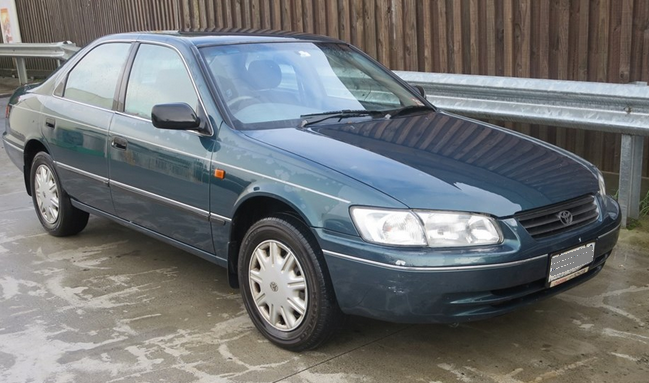
on the Camry – shown below - which entered volume production in 2003-2004:

Work on this vehicle started
in 2000, soon after my contract with Kenworth was so abruptly terminated. From
the onset it was done with the intention of the electrical system being fully
tested well before the start of volume production. After about two years
I received two side-kicks, two young electrical engineers new at Toyota.
Both around 30-years old, and both with some previous experience in electrical
industry: Paul T. with electrical motors, and Keith B. at Nissan in South
Africa. Both were very good engineers, and very good persons at that! They
eventually took the final phase of the project over, and I was able to
concentrate on my testing.
With this vehicle, due to
its many variations, I ended up with some 2000 possible combinations of
electrical components. Fortunately, with the delivery of first electrical
components, a young engineer, Anthony B., from wiring harness
manufacturer, arrived to assist. He downloaded my 2000 combinations into his
computer and managed to prune them down to some 1600-1700. With every
combination he prepared large sheet of paper with the list of components
required for the given test, and we were ready to start with Test Number 1.
Paul T., with a well-developed dramatic sense (his parents came from Greece) prepared
large board with chart of progress, on which we were recording daily output,
faults found, faults fixed, etc., for the benefit of our management, for which
we were praised up to Toyota’s heavens!
As it always happens, the
components we needed were not arriving according to our plans, so, instead of starting
with Test No. 1 we had to start with, say, Test No. 163, followed by Test 22.,
followed by Test 1234, but we managed, albeit with higher effort and slightly fogged
up thinking. The three months in the company of the two, sometimes up to four,
engineers and friends, remain firmly etched in my memory as the highlight of my
engineering carrier.
Needless to say, that when
the car eventually entered volume production it had no electrical faults.
I left Toyota at Christmas, 2003, but soon after I heard of several
of them, but none of them was of our doing: wiring harness manufacturer swapped
two wires in one sensitive component in such a way that it was impossible
to detect with our fairly primitive way of testing, and there was danger of the
wiring causing fire in the engine compartment. Also, there was problem with
batteries, which tended to lose charge after sitting in cars for many weeks
during shipment to Middle Eastern countries, and they had to be replaced on
arrival. Both of these problems I was aware of - and predicted in writing - on my way out of Toyota but was
unable to do anything about them.
After Toyota I worked
for a few months for a high-voltage switchboard manufacturer, also on
systems of electrical energy distribution for Schneider Electric, also for
General Motors again on a new Isuzu-GM commercial vehicle, and, finally,
for Toyota again, this time for their Service Department on the new Camry
Customer Manuals. This job I was working on from the premises of Holden
Special Vehicles company, when I was present at the meeting with the
Metropolitan Ambulance management. That shall be described in the next – LAST –
chapter.
Saturday, November 15, 2014
(32) Working as a contract engineer (6/8).
A small correction: in the previous blog two names of engineers from Toyota were mentioned – incorrectly. They were not there at the time; I worked with them some two vehicles later, in 2000 – 2003.
**** and
now back to the trucks I worked on in 1995 – 2000.
In 1995 our Company won a contract to design the electrical system for a few military vehicles. One of them was a multi-purpose chassis with cabin and with a Caterpillar diesel engine (one of the variations became the famous Bushmaster much later); the other was of a "jeep" type vehicle featuring a Renault engine, automatic transmission, a variety of day-and-night lamps and a platform for a variety of military shooting weapons. The design was going rather slowly for the vehicle was to be marketed around the world. Already, there were crews of engineers and mechanics from a number of countries working on it - USA, Malaysia, Israel, Australia, etc. Our Company, apart from design of the electrical system, was planning to manufacture (prototypes, initially) a number of control modules. Typical drawing of the instrument panel wiring for one of those vehicles is shown here:

While we were busy with work and frequent travelling from our office at Croydon to Ararat (electrical systems manufacturer) and Bendigo (Australian Defence Industries) we had an offer from a truck manufacturer, Paccar Industries (Kenworth Australia).
The company was producing trucks,
from the smallest, used for special purposes, such as concrete mixer, garbage
vehicle, etc., up to the largest, with their engine displacement of 19 litres.
The large trucks were able to pull up to 4 trailers, fully loaded with iron
ore, for example. There were several transmissions available, manual ones with
up to 18 gears, and also 6-gear automatic. Engines and automatic transmissions
were electronically controlled.
There
were two basic types of cabins: one for the trucks with the “nose”, and the
other for trucks without it. Both types of cabins were able to be extended by a
“sleeper” compartment. The chassis’ length varied according to requirements.
The undercarriage was from simple, one front and one rear axle, to multiple
front and multiple rear axles.
After
my previous experience with batteries and alternators, and electrical systems
in general, I was expecting some electrical problems – and was hit with a
veritable bonanza of them!
I was used to work around mass
produced vehicles, where every electrical component is designed to the minutest
detail. And not only that: the component must be tested, both mechanically and
electrically, to comply with the most exact requirements. After design process
is finalised the parts are evaluated by the manufacturing engineers for their
suitability for mass production – how to bring them to the production line, how
and where to position them, what implements are required for their handling, etc.
In other words, everything must click exactly as designed and determined by the
manufacturing engineers. There is hardly a shred of leeway for the production
personnel.
With
the trucks, and their low volume production (4 -10 trucks a day during my time
there), the assembly methods were largely
left to the production personnel. Design of components, and their suitability
for the purpose and manufacturing was restricted to the barest minimum.
Electrical compatibility of components was never looked at from the design
point of view. Special components – and there were many of them – were quite
often sent to the assembly line unpacked, to install in the trucks at the
operators’ discretions.
Quite
often the operators had no electrical training, and if they did not understand
something they were encouraged to walk into the design office to ask the
electrical engineer. Only then I
understood why at Peter’s table, and from now on mine, stood a queue of several
persons from the assembly floor; why his telephone kept ringing, why he kept
running between his office and the assembly line: there were no drawings for the
assembly to consult!
And
the time-honoured system continued on after my arrival! And what is more, I was
not familiar with the details. My stock answer had to be “I am sorry, I have to
find out and come and see you with the answer”. I, too, had to deal with the
incessant questions, torment the telephone lines, run between my desk and the
assembly line…
A
couple of weeks after my arrival I answered my telephone, and at the other end
there was a driver of a cattle truck, stuck somewhere in the middle of nowhere
due to a faulty starter motor. He was waiting day and night already for a
mechanic to bring and install a new starter motor. The driver actually did not
ring because of the starter, that he considered a done thing; he was asking
about something else. After answering I asked him to ring a little
later. Quickly I consulted starter motor activation in his type of truck and
discovered an error in the interconnection of components. When he rang later I
asked him if he was able to reshuffle some wires around the starter motor. On
his answering in the affirmative I asked him to grab a pair of pliers, cut some
wires around the starter motor, and re-join them in a slightly different way.
When he reported success I asked him to start the engine. I heard the engine
coming to life, and above the din his exuberant yodelling “it’s working, mate, it’s
working!!!”. I asked him to stop the mechanic from coming with the unnecessary
new starter motor and wished him safe trip.
After
this experience – and many, many similar ones, I began to adapt my old trusted
electrical circuit drawing to the basic electrical system of these trucks. To
this circuit I added everything I came across, new components, as and when they
arrived on my desk, until the entire system was thoroughly mapped out.
I
was lucky with the arrival of a new draftsman, an old Englishman, who professed
to know nothing about electricity, but was willing to learn. Thank you, Morris
Freeman, you learned everything, you were devil of a worker, and I would have been
lost for a long time without you!
I
decided to prepare for each and every new vehicle a complete set of electrical
drawings, suitable for both assembly line, and for the electricians in the
field. At the same time, I insisted that the assembly line is adhering to the
information in these drawings, which decision, at least initially, was not very
popular. The queues at my desk, however, became shorter and shorter, until they
disappeared; my telephone stopped its incessant ringing, my trips to the
assembly line became rarer and rarer. The reason was simple: each visitor, each
caller was told to go to the foreman’s office and consult the drawings.
From
my many years spent with passenger vehicles manufacturers I was familiar with
their assembly halls: spotlessly clean, well-organised, components stored in
neat containers along the assembly line, operators wearing uniforms, etc. The
truck assembly line looked like a large automotive repair shop, and it took
quite a while for me to get my bearings. I was lucky that I managed to transfer
a few line operators from the workshop into the engineering office: Tony, a
Filipino, draftsman; another Tony “Gumtree”, a cyclist who rode solo the Tour
the France route the previous year, technician; and German T. from Chile, a
design draftsman. With these three around me I finally began to feel at home.
In
the desk I inherited after the “professor” I found a Manila folder containing
clippings from various regional newspapers. These clippings contained articles
of various truck accidents that occurred around the country, where electrical
faults were the suspected “culprits”. For example, a truck ended up far in a
muddy field after “losing” all the headlamps in the middle of a bend at night;
a driver forced to jump from a moving truck when flames began to shoot from the
instrument panel; a truck written off after a fire destroyed the entire front
end… Some articles contained dramatic pictures, too.
I
concentrated on the possible causes of these accidents, from electrical point
of view. After my several months behind me already, I was not
surprised to discover a fair number of possible causes (= faults), and not only on trucks
from the past, but also on trucks I was currently working on, truck that still
had vestiges of the old electrical system in them! Therefore, apart from my
work on new trucks as they were passing across my desk, I began identifying
faults, correcting them, and slowly trying to implement these corrections in my work.
The
word “slowly” above was used deliberately, for resistance to change is always
considerable, even if the change meant correction of errors, improvement of
performance and savings of cost.
For
example, components suppliers are obliged to store certain number of components
available for use in case of urgent need. My changes were in a large degree affecting
cables and junction boxes manufactured by one company. The changes, involving
components that were used on many models for many years were implemented with ease
even if certain modifications to manufacturing process and tooling were
involved. The first problem arose when the manufacturer asked if the components
in storage should be modified as well. The answer, in my mind, was obviously
yes, but due to the cost involved I had to ask my management for permission.
The management decided that revisions of components in storage might indicate
to the customers that the components were faulty, and somebody could sue the
factory for past accidents: the components in storage remained faulty…
I
received the same reply when trying to increase output of alternators. My only success
was in elimination of the smallest alternators, but even the remaining largest
ones, with maximum current output of 160 Amps., were inadequate, especially in
trucks with several trailers, or in trucks with many non-standard electrical
components. An alternator that is forced to supply power in excess of its
rating for a prolonged period of time would stop functioning, in which case
the only source of electrical energy remaining are the batteries, which have a
fairly limited ability to do so.
My
apology for the use of simple language; more details can be found in my
blog
And
thus, I became a knowing partner of manufacture of trucks with faulty electrical
system!
Still,
in the meantime, I managed to rid the trucks of a great number of less obvious
faults, especially faults that did not require discussion with, or permission
from, the management. For example, there were no flames shooting from the
instrument panels of “my” trucks; they were not “losing” headlamps in critical
moments (actually never); their batteries were not “dying”, as long as their alternators
were functioning; they did not have fires in the engine compartments, or
anywhere else for that matter; and many others, that I considered my “consolation
prices”. Most of these improvements consisted of revisions to the fusing
system, and to strict adherence to selection of cable sizes according to my old
electrical circuit evaluation method, developed previously over several models
of passenger vehicles, and refined for the trucks.
One of my favourite models was T300 for which I was allowed to design an entirely new electrical system:

One
of the very few important things I managed to achieve was the removal of stipulation
that the users of these trucks are able to modify their electrical systems as
they see fit, for the system is – it was claimed – robust enough to cope with
additional headlamps, driving lamps, trailers, air conditioning systems, and so
on. The system was anything but robust, and each of these additional components
caused the wires to overheat and melt, fuses blowing, alternators failing, etc.
The stipulation was even used as an advertising gimmick – and it was false! I
was not aware of it until a year or two into my tenure, and I became aware of
it under fairly dramatic circumstances.
One
day I received a severe telephone dressing-down from one owner of a large
number of our trucks. According to him, each time he tries to dial a number on
his newly installed telephone in his trucks (this before the mobile telephone
era) his engine stops. After me he administered the same dose of dressing-down
to our chief engineer, who began to monster me for endangering the sale of some
20 new trucks to the same customer.
Afterwards,
a quiet investigation revealed the obvious. My tenure coincided with
introduction of new generation of diesel engines, that were electronically controlled
(the previous engines had purely mechanical system of control). The new engines
had a number of electronic sensors on them, their injection system was
electrically activated, and the whole system was controlled by a new electronic
control module. Resultantly, the trucks had a large number of additional wires,
new fuses, new wiring harnesses, etc. The mechanic, installing new telephones
in the irate customer’s trucks, was connecting telephones using the old
time-honoured method: red wire is positive, blue wire is ignition, white wire
is earth. Unfortunately for him, the red and blue wires he selected from the
multitude of new wires (without consulting wiring diagram!) were serving
something or other in the engine management system. Thus, when the owner
dialled a number on his telephone the engine management module received a false
signal and promptly shut the engine down…
From
that time on the customers were not allowed to add anything to their electrical
system, or modify it, without approval by the engineering department.
The
number of vehicles produced by this company during my time was about 4 – 10 per
day. If the number dropped below 4 the company had to reduce the number of
operators on the assembly floor. Around the end of 1999 the number dropped to
about 3. There were rumours that if the number drops to 2 the reduction of the
number of operators in the engineering department will follow. And, sure
enough, around mid-2000 the number dropped to 2, and a few weeks later we
contractors, some 25 of us, were called to the chief engineer’s office, and
dismissed on the spot.
For
me, the 5 years spent with these trucks were fairly interesting. I was able to test and perfect my
method of electrical system evaluation, and also to apply it in real life; I
met a number of good people, both in the design and manufacturing departments,
even among the managers! For one year I was the company’s golf champion – the large
Cup with my name engraved on it is still on display in the cantina, I heard.
The company culture rubbed against my hair, of course. By “culture” I mean the
sweeping under the carpet of the numerous faults, their resistance to change no
matter how justified… That “culture” is, however, endemic in the automotive
industry, and I am inclined to believe that in other industries as well.
Saturday, May 24, 2014
(31) Working as a contract engineer (5/8).
I finished
at Mitsubishi in January, 1993. After a few weeks at home I received
a 'phone call from Peter H., whom I met on a few occasions
at meetings with suppliers for Mitsubishi; Peter used to turn up at these
meetings representing some trucking company. On the 'phone I was told that
he heard I was free from Mitsubishi, and would I be interested in
a job as a design draftsman for KW truck where he was Chief
Electrical Engineer. Having nothing else lined up I agreed. At the
previous meetings I called him Professor, for everybody else was addressing
him so. At KW, to my astonishment, I discovered that the nickname –
as I took it to be – was true to form: on the nameplate above his desk was
his full name, Prof. Dr. Eng. Peter H. Wow! I stopped calling him
professor and restricted myself to the more common way of addressing him as Peter.
I started
there as a draftsman in April, 1993. For work they had new computers
whose brand name now escape me. Their system was somewhat different from those
I used before and it took me a day or two to understand their tricks.
The
factory manufactured large trucks, mostly designed to pull trailers, one, two,
up to four trailers, sometime even more. Size of these trucks can be guessed at by
the size of their engines – diesels, with 8 to about 20 litres of displacement.
At the time of my start Kenworth was doing away with the mechanically injected
engines, and began to use engines with electronic fuel injections. That EFI
system was even a bit more complicated than the one I was used to
from my work on passenger vehicles previously.
Alongside
my work I could not help myself looking at these trucks from my electrical
point of view. The first glance was rather surprising! I always start with
the evaluation of alternator and battery sizes. A quick calculation of
electrical current requirement at the common high-electrical-demand continuous operating
conditions (engine working, air conditioning working, external lamps turned on,
a couple of trailers behind, etc.) gave me a figure well in excess of
200 Amps. electrical current requirement. Alternators on these trucks were able
to deliver between 60 and 160 Amps. electrical current maximum! A quiet
inquiry with the Service Department revealed that the electrical components
suffering from greatest number of failures are – alternators and batteries!
Hardly surprising, for alternators fail when they are subjected to continuous
demand above their rated capacity, with the battery failures following closely behind.
Inquiring
with Peter’s sidekick, a young electrical engineer N. C., confirmed to me what
I suspected: that in a motor vehicle the main electrical power
supplier is the battery, with the alternator serving as a battery charger
only! It happens to be exactly the other way round, but I thanked him for
the information, being but a general draftsman...
As
the time went by I discovered quite a number of dubious electrical things until
I decided (for myself) that the electrical system in the company is in
fairly incompetent hands and decided to seek contract somewhere else. As it
happened, Toyota was looking for someone to assist their electrical engineer
with the design of the electrical system for the car being prepared for
production, and I accepted the job.
KW
people expressed disappointment: „Don’t you like it here? “. As a matter
of fact I didn’t, and we parted ways amicably.
At
my new place the local electrical engineer Trevor J. quietly confided in me
that he is not extremely keen on the electrical system, and could
I concentrate on that while he would be doing the administrative side, that
is parts list, releases, contact with the local Japanese engineers and such:
nothing could be more pleasing to me than that!
I spent
two periods of very pleasant time, working on two successive models of Camry:
 The white Toyota Camry was also marketed as GM Apollo.
Trevor
J. turned out to be a very pleasant friend and a colleague, and we
managed to steer both models through all the phases of design, development and
testing to a successful start of production. Very successful, except for
one minor blemish: the first of the two models, the white one pictured above,
had quite a few electrical problems at the start of the production. Very few – if any – were caused by our design. Majority were caused by faults
in manufacture, mainly in the manufacture of wiring harnesses. In my judgment
at the time, the parts, hundreds of different parts, were manufactured and
tested individually by their manufacturers. The problems arose when parts from different
factories were assembled together in a vehicle. We both humbly accepted
the opprobrium heaped on us by the management (despite of the fact that only a tiny
minority of electrical problems were our fault), and decided to invent some
sort of testing of the electrical system prior to the start of production.
With
the second model our roles, Trevor’s and mine, were separated officially, and I was
to a large extent on my own. Parallel with my main work I began to
design some sort of electrical system testing.
For
testing I asked for a large table to be installed in the engineering
department’s storeroom. On the table I put
as many standard car components as I was able: battery, engine bay
electrical components, instrument panel, door locks and window motors, radios,
headlamps and tail lamps, etc. All these components I connected together
with wiring harnesses as they were being made available from pre-production
runs. And then I started creating various situations...
Electrically
speaking, the car was not one, but several hundred of slightly different
vehicles. For starters, the car came with two different engines, four- and a six-cylinder
one; manual and automatic transmission; several different air conditioning
systems; a number of electric windows options, door locks options and
alarm system options; several different radio and speakers arrangements, to
name but few. When I connected (on paper) all these different arrangements I ended up with several hundreds of tests. Despite having one colleague
(radio engineer Bill W.) on hand to assist the task was beyond me. I asked for some
assistance from the testing department, but was given (for some 5 weeks only)
two university students, on leave from their 4th year of electrical
engineering.
Of
the two, Carmen turned up to be like supercharged dragon at work: understood
the task at the first glance, was ready to start interconnecting and testing
almost immediately, and even, after a couple of weeks started coming up
with improvements and most welcome simplifications – mind, I myself was
still only wrestling with the job... Fernando (both of their parent were of
Spanish origin) was a bit slower, but the three of us managed to „de-bug“
the electrical system so that the start of production happened without a hitch.
Thank you, Carmen, thank you Fernando...
I still
had a few weeks of work at Toyota left on my desk when I received a surprising
telephone call from Kevin D., Human Resources Manager at KW: „Charles,
how much longer are you planning to stay at Toyota?“. I told him that it
could be a month or two. „O. K., can you start as an electrical engineer here
at KW, when you finish? “. After agreeing on the conditions and on the
salary I promised to give him a ring.
Three
weeks later my desk at Toyota was clear, I reported back to Kevin, and a few days later on Monday, I reported to Gary
H., the Chief Engineer at KW. He took me to the „Professor’s“ table,
wished me good luck and went back to his glass office. Turning to Peter’s assistant,
the electrical engineer N. C., I asked about Peter: „He left last Friday“,
was the surprising answer. And what am I supposed to do, I asked? „The
same as Peter, and I now have batteries and brakes“, answered N. C.
And
that was the start of my 5-years long carrier at KW...
Friday, May 23, 2014
(30) Working as a contract engineer (4/8).
For
Nissan on their Pulsar/Astra electrical system I worked from outside, usually
from a nearby office that belonged to my friends, or even from home. In my work
I had nearly absolute freedom; meetings with Nissan engineers (usually Greg Hall & Ian Stanley) took place only
every few weeks, or whenever I needed. My drawings were accepted almost without
a word; a few little changes required were due to changes in Nissan components,
or to facilitate future manufacture.
Mitsubishi
was different. They did not accept my Macintosh, nor any drawings produced thereon. They insisted on my using the drawings produced in Japan, and on changing them in pencil for revisions back in Japan.
At
the time Mitsubishi was preparing a car for export to the U. S., there were
already a few prototypes undergoing tests, and my initial brief was to make
sure the electrical system is without faults, for “you know how the Americans
are keen on taking things to courts". The car’s American name was Diamante:
.PNG)
The
one pictured here stands in the second-hand car yard somewhere in America, it
is about 18 years old, and still looks quite handsome for its age. I liked driving
some of the prototypes, back in 1991. Its every electrical component found
itself in my hands at least a hundred times…
The
car had 3-litre petrol EFI engine, four-speed automatic gearbox, and it is a front wheels drive. It had everything a compatible car of that vintage had: air
conditioning, bags, theft-prevention measures, eight speakers with an
additional volume-booster…
The
time allocated to me for electrical check was fairly short, some three months;
I knew what to do, except I didn’t have a suitable method and had to start
from the scratch.
The
main problem was with the flow of information in the Mitsubishi company. At my
disposal were drawings of the electrical system, produced in Japan for all the
subsidiaries around the world. The drawings contained all the components
required for the same model in every country where the car was intended to be
manufactured. My first job was to reduce the drawings by elimination of the components not
required in the intended marked, in my case the U. S. Also I had to add to
these drawings components that were not known when the drawing were being
made. Marked-up copies of these drawings – some 20 of them - were then made
more presentable by a draftsman and sent to Japan for corrections.
Soon
after faxes began to arrive from Japan questioning the changes. The faxes were
in Japanese, translated in our office by a translator who was not familiar with
the electrical terms in them. My replies were equally inelegantly translated
into Japanese by her, and sent back to Japan.
In
that merry-go-round of faxes the correct
method of behaving towards the Japanese colleagues was explained to me:
(allegedly) for the Japanese the word “no” in discussions is offensive. The
correct method of argument is “your distinguished suggestion is correct, would
you be so kind as to consider this or that as well?”. The answer from Japan to
our proposal – if it ever came! – was always in the form that “the drawing
so-and-so-was changed to such-and-such and we request that you change your
design accordingly”. Reply in the form “thank you for your suggestion and
returned herewith is the revised drawing” was not known by Mitsubishi in Japan.
In
the meantime the time was slowly running out, local suppliers were clamouring
for signed production drawings, and I was wrestling with my job of checking the electrical
system.
As
is the way of life in all automotive companies a new manager arrived in the
electrical department. His first act was to call meeting of the department
(some 6 engineers and about 10 draftsmen) to enquire how often we should call
such meetings. He received no reply from us; we were not in need to have
meetings, we needed a manager who would understand our work – Steve L. was not
that kind of manager. I discovered it within days when I asked him for
discussion about some 150 items I compiled to date during my checking of the
electrical system. I was told that he is not an electrical expert (he was
nothing electrical, that is), but that in a few days he is going to present
himself at Mitsubishi in Japan where he could put my questions on the table.
He
went, he came back, and after a couple of days I knocked on the glass window of
his office. What I heard was what I was half-expecting: he did not feel
competent to discuss such deeply technical details, and what is actually wrong
with them? I explained to him, as gingerly as I was able, that about one third
of the items may cause short circuit, even fire, if not corrected; another third are cost
saving measures, and the last third are simply drafting errors. Since I refused
to sign those drawings which contained the short circuit causing items he
signed them off himself…
As
an employee I used to suffer deeply from such deliberate acts; as a contractor
it was only my cynicism which received a boost – if you want your car to be
imperfect, who am I to argue!
The
volume production began and the car export took place with all the faults and
unnecessary additional costs. Many years later I read in the press that
Mitsubishi worldwide was for many years concealing problems with their cars - what a surprise...
In
the meantime new markets opened for the car, this time in Europe, and, as a
result, instead of the initial 3-4 months I remained at Mitsubishi for nearly
two years. I was working on models for various European countries, such as Great
Britain (r. h. drive plus headlamps adjustments), Swiss (heated front seats),
Swedish (daytime headlamps), German (same as Swedish except without daytime
headlamps), etc., etc.
While
working on these cars, overseeing testing and revisions, I was perfecting my
method of electrical system testing, which proved to be fairly handy in some of
my future contracts.
Subscribe to:
Posts (Atom)