A few details.
In the territory of Slovakia, the main air traffic
orientation points were marked by radio beacons called NDB (Non-Directional
Beacon); also, commercial station’s radio transmitters were used by the
airplanes. One such popular transmitter was Radio Bratislava, located at Veľké Kostol'any. Radio beacons were located at all
airports, and also at points important for air navigation, for instance at
Břeclav, Nitra, Štúrovo, Jelšava, etc. Computers at the time were unheard of,
except for darkly ominous newspaper articles, where the „cybernetics“ were
described as burzhoazie pseudo-science, devised to better exploit the
proletariat (this just as an illustration of the political atmosphere of the
time).
In relation to computers, I cannot
miss an observation about the work of the computer we all carry in our heads.
The Air Traffic Controller, in the
course of his function, has to keep in his short-term memory a number of
various bits of information from a variety of sources, and on the basis of
this information he solves a variety of conflicts. Let’s say he makes
a mistake, any kind of mistake, serious or insignificant. In an absolute
majority of cases, he would stop after a minute or two, and returning to
the moment the mistake was made he corrects the mistake. If, however he is in
his work interrupted by something outside his sphere of duty – the mistake
would be often forgotten.
Apart from communication with the
airplanes by variety of means the controller cooperated with neighbouring Area
ATCs (Austria, Czech, Poland, Soviet Union and Hungary), with airport towers in
Slovakia (Bratislava, Piešťany, Sliač, Poprad a Košice), with military
ATC, and even with aero club airfields, or organisations with vested interests
in air transport (airlines, police, etc.). The cooperation was chiefly in the form of air traffic
information and solving of various problems associated with domestic and
international air traffic.
The controller even had a „red“ telephone
at his disposal, actually an ordinary black coloured variety one, that was connected
somewhere high to the State Security (StB) organisation, or the Communist party
(virtually the same organisation). We did not have any telephone directory for
this telephone, the messages were exclusively one-way. Usually when it rang
some important sounding voice was demanding various services (nobody ever asked
if we were busy at the moment, if a collision between airplanes is imminent, for instance –
God only knows what the other end was thinking about us). I, for instance, had to
„quickly!“ run a few times to the airport passport office a few
hundred metres away, to ask their boss not to bang his rubber stamp into the passport
of some passenger for „it would be fixed by the Communist Party“. From those
days I remember one individual from somewhere in South America by the name
of Gilberto Vieira, whom I was entertaining in the café for half an hour,
waiting for him to be collected by the Security Service gorillas. His command of English was not exceptional, and he addressed me "comrade"; he was a bit uneasy to hear from me the word Sir in return...
Connection with the neighbouring ATCs
(towers, Area ATCs, etc.) was by means of direct telephones, less frequently by means
of teletype. The latter one was reliable, but slow; telephones were, mildly
put, temperamental. With the airport towers in Slovakia telephones the connection was largely
reliable. Problems arose when the local tower operator was not immediately
available, away on lunch break, or whatever. When situation arose that required
his involvement, emergency landing, for instance, we had to contact him (or the
local police, State Security, military garrison, or whomever) by any means
imaginable; mobile telephones were at the time some 30 light years away...
With the neighbouring Area ATCs the direct telephone connection depended on the whims of the day: with the Austrian and
Czech ATC it was reliable; with the Hungarian ATC the connection depended on
the weather along the above-ground telephone lines – winter months were
especially bad; with the Polish ATC the connection was sometime available and
sometime not. Telephone connection with the Soviet ATC was available but seldom; as to myself, I do not
remember speaking with them even once! Prior information of airplanes incoming from the direction of USSR, required by law, was seldom on hand. The Soviet airplanes, despite required by law to contact us well prior to entering our airspace, ignored the law. First time we discovered they were in our airspace was when they contacted us on the radiotelephone. Our reception being poor we heard from them only when they were well halfway in our airspace. Sometimes we received information about their presence from our military colleagues, sometimes even from the airport towers these airplanes were flying nearby.
Contact with the airplanes.
Airport towers used radio telephone for
contacts with the airplanes; in 1961, the year I started at the Area ATC
Bratislava, the contact with the airplanes was exclusively by means of
medium-wave telegraph.
The ground-based telegraphists had their
own little office, and messages from, and to, the airplanes, written on pieces
of paper, were carried along the long corridor. Urgency of the messages had
different meaning for the ATC Controller and for the telegraphist. If, for
instance, the telegraphist stopped in the corridor for a chat with
somebody, the message had to wait a few (or many) long minutes for
delivery. Telegraphists, apart from the receiving and carrying messages, had
a variety of other duties. For instance, transmitting messages to airplanes about the
airports, meteorological reports, and also "homing". This was done at the request
from the airplane, when the bearing of the transmission from the airplane was
determined by rotating the telegraphist’s directional antenna. The airplane, with
the help of bearing from at least two different telegraphic ground-based stations
was able to determine its geographical location. All these „other“ duties were
slowing down the flow of information between telegraphist and the ATC
controller.
Airspeed of most airplanes at the time
was between 250kmh (Li-2, for instance) and 450kmh (a DC6). In terms of
distance, these speeds represented between 4km/minute and 7km/min. There were
also a few jet airliners in the air already (Tu-104), with airspeed of
about 850kmh, and the distance flown with that airspeed was 15 kilometres per
minute = 75 kilometres in 5 minutes! Connection by means of telegraphy, with
the associated slow-shuffle along corridors, was almost meaningless, especially
with regards to the small area of Slovakia (roughly 200 x 400 kilometres).
Also available to the Area ATC were two
radio telephone transmitters/receivers, working on short wave frequencies
(around 4600 and 6500kHz). These were used but very seldom, for the frequent
„dead“ areas of reception, and for strong interference from a variety of
sources, such as electrical storms, solar flares, etc. When Short Wave Transmission/Reception (a.k.a. VHF), common in aviation around the world, was mentioned to the management they went into spasms! Their resistance to such
outrageous novelty (even some of the colleagues, let alone
telegraphists) was considerable, because nobody had any experience with radio
telephony. There was also a language barrier: in telegraphy,
a so-called Q-code was being used for virtually any kind of message. For
instance a weather forecast was labelled QAM; flying time and height over,
say, Nitra, was called QAF Nitra 1234/1800; airport closure was an ominous-sounding
(to us, still) QGO, etc. In radio telephony, four (!) languages were mandatory:
the local Slovakian, Czech, Russian and English. The first two languages were
o.k. For English a smallish booklet of official phraseology was available
(excellent for the WW2 air traffic); booklet of Russian phraseology was not
available (if it ever existed).
Around 1963 the pressure to do away with
telegraphy was becoming so strong, because the airplanes were gradually doing away with their telegraph operators. Finally, microphones began to appear in our
office! These were operated by female radio-telephonists (with the phraseology
booklet at hand), and messages were still flying to-and-fro on pieces of paper.
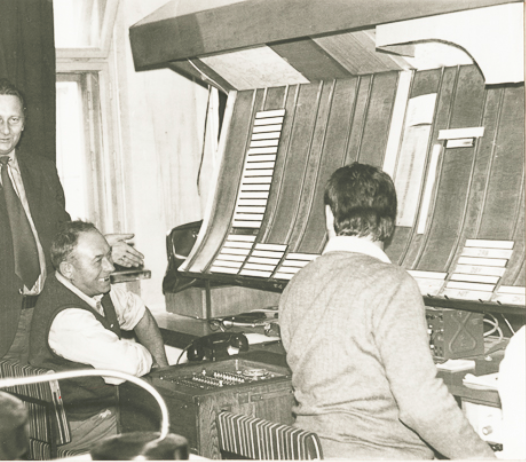
The distance was not along the long corridor, it shrunk to just across the
table. In the accompanying poor-quality photograph, the radio telephone
operator sits on the left, the controller sits behind the slanting board:
The Controller eventually received his
microphone a year or two later.
With the arrival of microphones another
problem turned up. That should have been, of course, solved BEFORE, not after,
but it wasn’t, and I doubt anybody as much as mentioned it.
It happened thus: radio transmitters and
receivers on Very High Frequency (VHF) were located at the Bratislava-Ivanka airport, in the very corner of the Slovakian territory. Due to the hilly terrain,
also due to their short-range antennas, and also due to the curvature of Earth, contact
with the airplanes at most frequently used heights was possible to about 50-150
kilometres from Bratislava; with the very few airplanes flying higher at the
time (5,000-10,000 metres) the contact was possible up to about 250 kilometres
from Bratislava. Slovakia is, however, some 400 kilometres long and 200 km wide, and the Area
ATC was responsible for air traffic control over its entire territory; also, for responsibilities
other than air traffic control it is important to be able to communicate with
the airplanes to at least several hundred kilometres OUTSIDE Slovakian
territory. With the air taxis, flying usually only a few hundred metres
above ground, the contact was possible to only about 50-70 kilometres from
Bratislava. They, too, were LEGALLY entitled to the Air Information Service, to
Emergency Assistance Service, to the Search and Rescue Service – provision of
all these services was the responsibility of the Area ATC.
In summary, coverage of the territory of
Slovakia with the radio communication service on VHF was insufficient.
According to the
laws of the time, planes arriving from abroad were obliged to contact the Area
at least 10 minutes before arrival at the border beacon and ask for permission
to enter. When the only method of communication was radiotelegraphy, this law was
seldom violated, because radiotelegraphy could be used even from Africa.
However, when the Very Short Frequency (VHF) connection was established, planes
arriving from Poland and the Soviet Union could not call unless they were at an
altitude of at least 5000 meters, which was
majority of them at that time. I don't know what our leadership was doing
at that time when this violation of the law was widely known. Airplanes from
the Soviet Union ignored this law, even when they were high enough to be able
to call; they ignored it even when radiotelegraphy was still used, when they
could even call from Moscow. They just didn't ask for permission. We usually
learned about such an aircraft when it was already over our territory for a
long time. Sometimes the planes called the military air traffic control,
sometimes some civilian airport, usually Košice or Prešov. Fortunately, there
were not many of them, they flew more often over Czech air traffic control. I
don't know about their way of announcing themselves, I haven't worked there
often enough.
Looking
at this dismal coverage by voice radio-communication equipment it beggars
belief that this cavalier and certainly illegal situation was allowed to exist: here
you are, Comrade Controller, area of some 80,000 to 240,000 square kilometres in
size, in which are flying airplanes in all kinds of meteorological conditions.
Under the law you are responsible for maintaining prescribed distances between
them, you are obliged to maintain UN-interrupted contact with all of them, you
are responsible for organisation of emergency situations, and dozens of other
duties. And here you are, at your disposal, transmitters and receivers that are
capable of maintaining contact with these airplanes flying over between 10 up
to 70 percent (if that!) of the territory under your control. What happens to those 90 to
30 percent of airplanes that you are unable to communicate with if they happen
to get into some knotty situation? Are you complaining? You cheeky unsatisfied
bugger!!! Don’t you know that YOUR Communist Party and YOUR Government have
much more important matters to deal with than your piffling little complaints?
What do you have against our political system to burden it with your nearly
malicious constant complaints???
Believe me or not, that's how the so-called
People’s Socialist system operated!!!
Today
this „performance“ of the State administration would be termed something like
gross negligence punishable by law (I am not a lawyer, please forgive me those
of you who know better).
I could
never understand the international aviation agencies, ICAO, IATA and others,
for their inability to see the poor to dangerous activities of transport
administrations in these communist countries (and no doubt other countries as
well, some African countries come to mind).
At the time, some airplanes have telegraphists on
board still, and contact with these airplanes was over 100% of our territory
(albeit contact of a slow and ponderous kind – see previous chapter). And
we had a radar at our disposal, too...